
Clinton County Supervision Types
Parole and probation both allow a person to live in the community under rules, yet the legal paths differ. A parolee first served time in an MDOC prison. The Michigan Parole Board then granted release after the person reached legal eligibility and completed release preparation. MDOC still has jurisdiction during parole. Probation begins with a court sentence and does not show, by itself, that the person served a prison term. The sentencing court keeps legal control while an MDOC agent supervises compliance.
Bond release is different from both. Someone can leave Clinton County Jail on bond while the case remains pending and have no parole or probation status. Final discharge is also distinct. It means MDOC jurisdiction over the displayed sentence has ended, though a separate case or authority can still exist.
| Record point | Parole | Probation |
|---|---|---|
| How it begins | Release from an MDOC prison after a Board grant | A sentence imposed by District or Circuit Court |
| Prior prison term | Yes, for the parole case | Not required |
| OTIS status | PAROLE | PROB |
| Who keeps jurisdiction | Michigan Department of Corrections | The sentencing court, with MDOC supervision |
| Completion | Parole termination or maximum discharge | Court and supervision termination |
- Jurisdiction
- The legal authority an agency or court retains over a sentence.
- Discharge
- The end of MDOC jurisdiction for the displayed sentence.
- Absconder
- A person reported as missing from or out of compliance with supervision.
- Revocation
- A formal action that can return a parolee to custody after the violation process.
Check Clinton County Supervision
The public person-specific starting point is the Michigan OTIS search. OTIS covers current MDOC prison, parole, and MDOC-supervised felony probation records. It also includes some interstate compact, escape, absconder, and recent discharge records. It does not cover every person whose only custody was Clinton County Jail. A jail-only release must be checked through the Sheriff and the court instead.
- Search by MDOC number when known. It is the strongest unique key. Otherwise enter the last name, then narrow by first name, age, sex, race, or status.
- Open the likely profile and compare the commitment name, date of birth, court, and sentence. A matching name alone is not enough.
- Read
STATUSandLOCATIONtogether.PAROLEandPROBshow different forms of supervision. - For a parole record, compare
DATE PAROLEDwith the eligibility and maximum fields. Only Date Paroled identifies the actual prison exit on parole. - Use the listed office or MDOC directory to confirm public procedure. Staff can limit case-specific disclosure.
A blank result is not proof that supervision ended. The spelling may differ, the commitment name may be older, or the person may have a jail-only matter. OTIS also removes discharged profiles from public display after three years, unless a set-aside or operation of law removes one earlier. For an older case, use the Clinton court record or a focused MDOC records request. The full county release path is described on the Clinton County released-inmate search.
The manifest image below comes from the official OTIS offender search and shows the state search controls used before a supervision profile is opened.
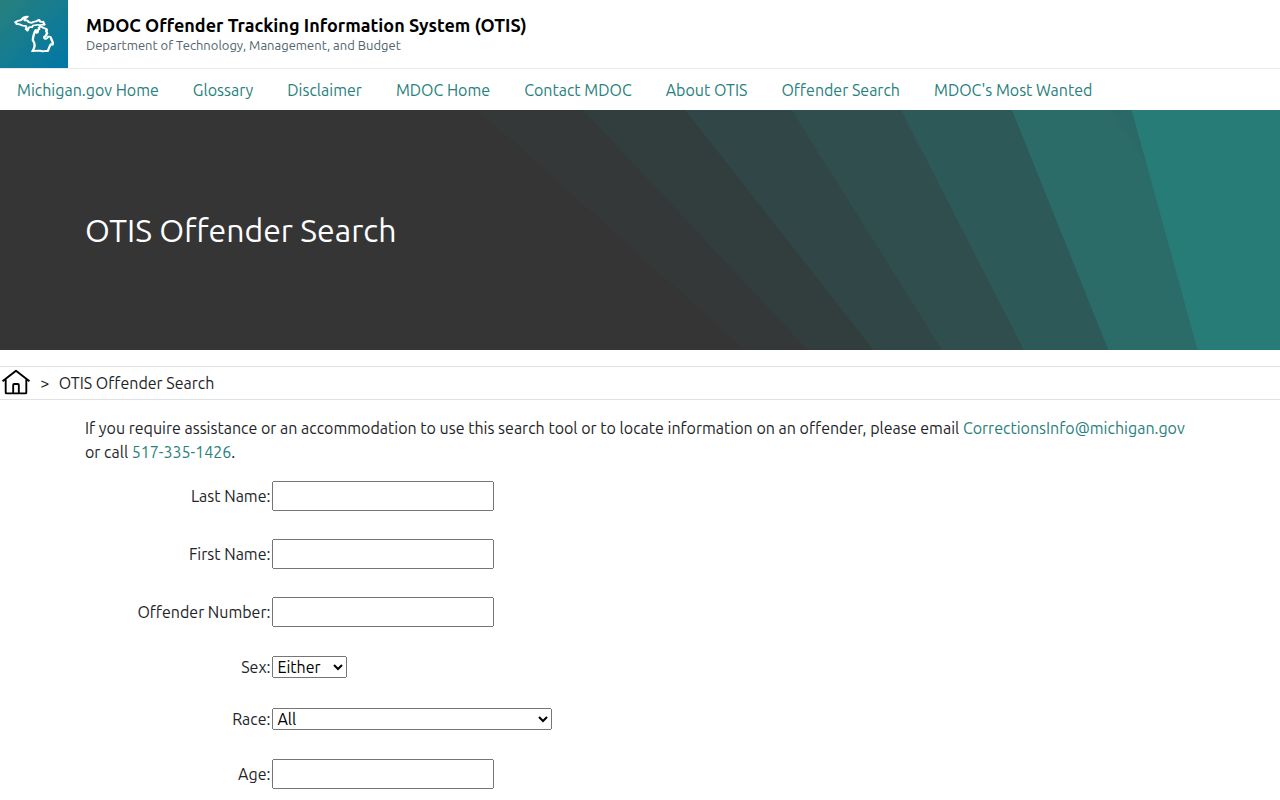
The search form is only the first step. Identity fields, status, location, and dates on the resulting profile must agree before the record is treated as a match.
Important: A current-custody roster is not a released-person supervision search. OTIS covers MDOC jurisdiction, while Clinton County Jail confirms a local custody departure.
Clinton County Parole Office
MDOC places Clinton County in Region 7. Its regional office directory identifies the local parole and probation office in the county courthouse complex. The office can explain reporting procedure and direct a caller to the right unit. Public access does not mean that staff will release protected case material or confirm every detail about a named person.
Clinton County Parole/ProbationCourthouse Suite 3200
100 E. State Street
St. Johns, MI 48879-1571
Phone: 989-224-5133
The Circuit Court Probation page describes the local office as a liaison among MDOC, the courts, Clinton County Jail, the Sheriff, other agencies, and the public. It also prepares presentence and court-ordered reports and supervises felony probation compliance. That role helps explain the local system, but the page is not a public name-search database.
The official Clinton office listing is pictured below. It is useful after OTIS points to the location tied to the matching record.
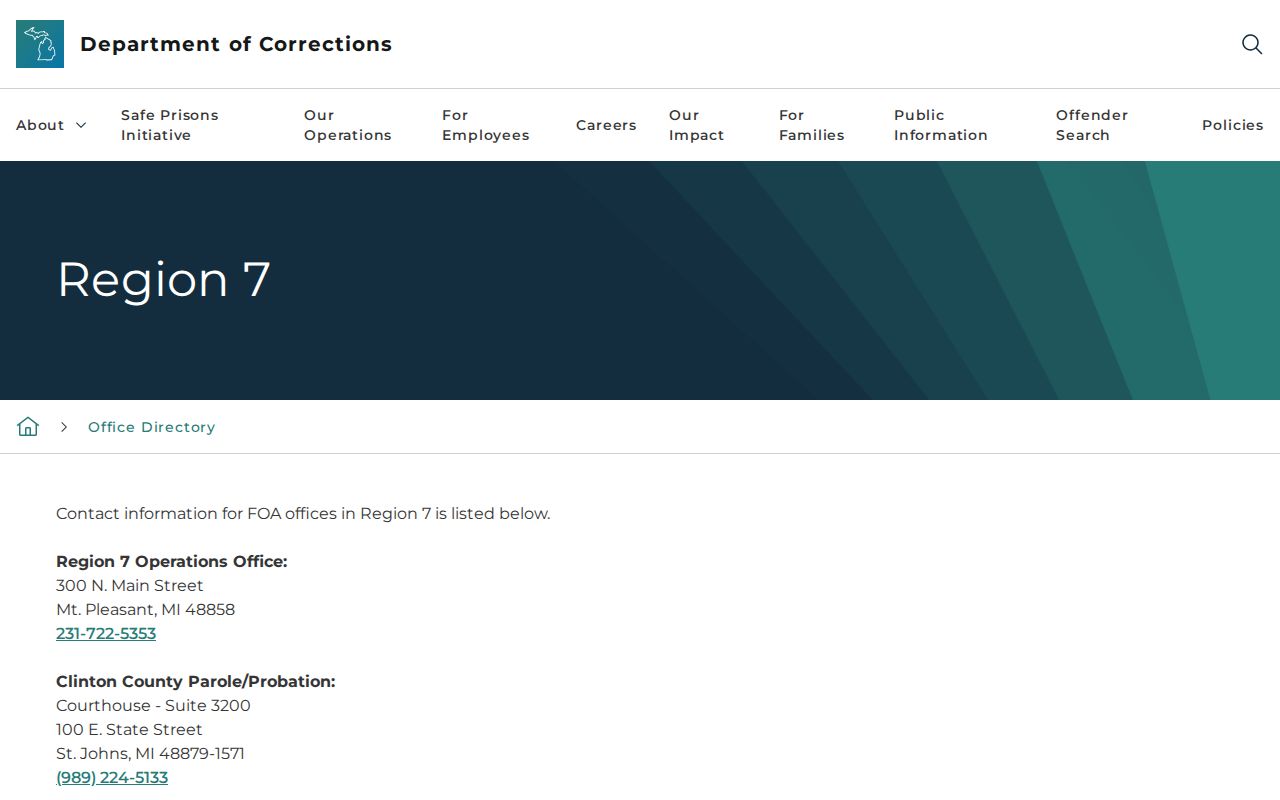
The directory provides the proper office route. It does not replace the person-specific status and identity checks in OTIS.
Clinton County Probation Reporting
Clinton County has a second local layer for District Court probation. The 65A District Court Probation page publishes monthly reporting days by surname range. Its posted schedule appears to contain an overlap in letter ranges. A person should therefore call the office and confirm the assigned day instead of inferring a date from a copied range.
65A District Court Probation100 E. State Street, Suite 3400
St. Johns, MI 48879
Phone: 989-224-5157
Monday through Friday, 8:00 a.m. to 4:45 p.m.
The schedule governs reporting logistics. It does not prove that a named person is on probation. The court file and an OTIS match provide the person-specific foundation. The office then supplies current instructions to the supervised person.
The county’s District Court probation schedule is shown in the official capture below.
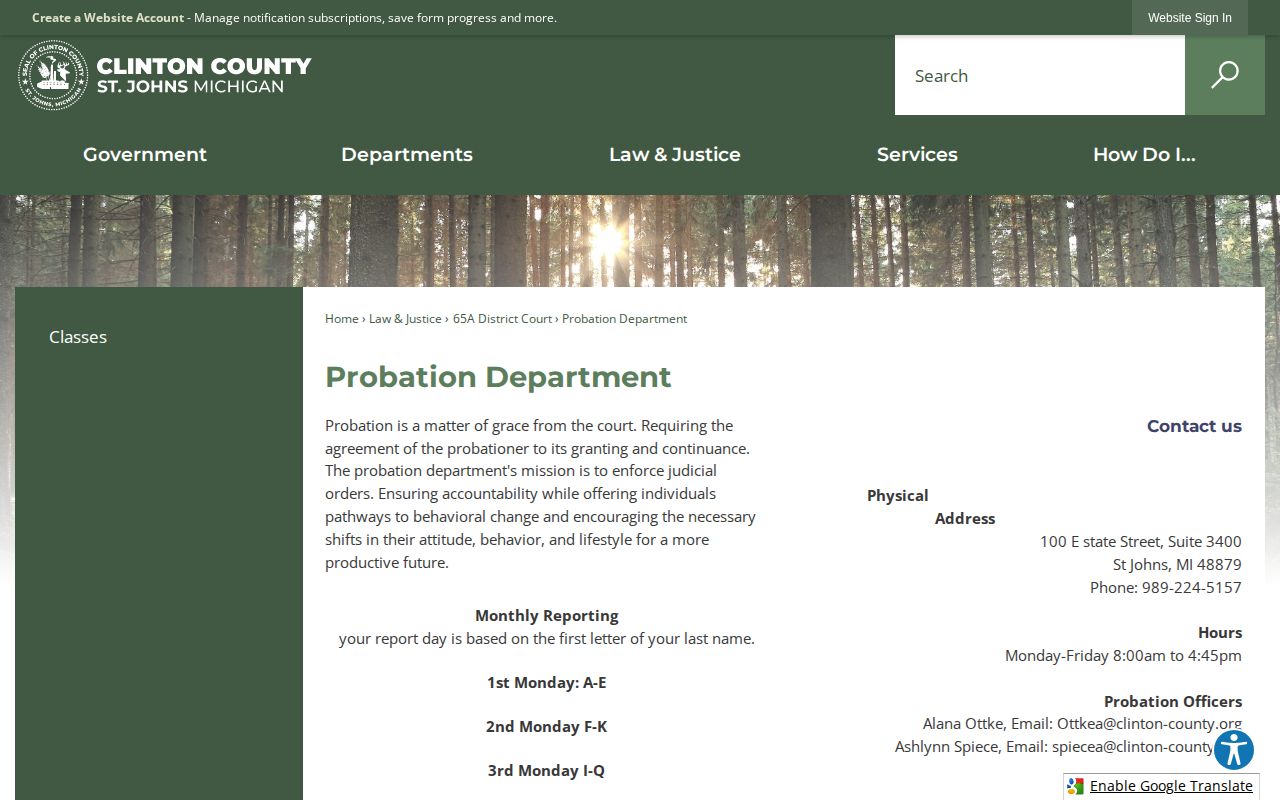
The source should be checked directly because the posted ranges may change and the apparent overlap calls for confirmation.
Note: Reporting days are administrative instructions, not a public list of every person under Clinton County probation supervision.
Clinton County Absconder Status
OTIS uses specific codes for unresolved supervision. ABSCOND1 means MDOC reports a parole absconder actively sought by the department. ABSCOND2 identifies a probation absconder under the sentencing county’s jurisdiction. Neither code is proof of a new conviction. It is a supervision status, and the current agency record must be read as of its update time.
A violation does not produce one automatic result. Parole can be revoked through the violation process, which may return the person to custody, or the person may be reinstated to supervision. Court action can also affect probation. Anyone trying to confirm a current status should avoid drawing a conclusion from an old screen capture. Recheck OTIS, review the public court register when relevant, and contact the listed office for procedure.
MI-VINE serves a different purpose. It can report supported custody events such as release or transfer, but it is not the authoritative record of every parole or probation condition. Direct crime victims seeking broader MDOC parole eligibility, hearing, decision, transfer, or release notices must use MDOC Crime Victim Services as a separate registration channel.
The Clinton County Victim Rights process adds another narrow channel. On an eligible victim’s request, the arresting agency can give notice after the Sheriff or facility reports the custody change. The county also describes requested notice for day parole or work release. That process serves people who qualify under victim-rights law. It is not a public supervision lookup, and it does not replace the person-specific OTIS status.
Property After Clinton County Release
Clinton County separates inmate property from evidence or other personal property held by the Sheriff. The Sheriff’s Office page says inmate property release is by appointment at 989-227-6582. That wording may include property authorized for a third party, so it should not be treated as a promise about the standard discharge handoff.
A different appointment applies to evidence and personal property. The Evidence Technician process uses 989-668-3121. Release from supervision does not automatically authorize return of every item held as evidence. The correct office must first determine whether the property can be returned.
This distinction matters after jail release and while a person is on supervision. Calling the correct number avoids treating jail-held inmate belongings and case evidence as the same category.
Clinton County Parole Hearing Limits
Michigan’s visible public-hearing registration page is not a calendar of routine parole interviews. It covers the narrower public process for listed lifer-law, commutation, and pardon matters. Notices generally appear through MDOC press releases about two weeks to 30 days before the hearing, so a missing name does not show that ordinary parole consideration is inactive.
The Michigan parole consideration process separates an interview or Board action from physical release. A grant still moves through release preparation and can be affected by notices, placement, detainers, misconduct, or other checks. OTIS Date Paroled and current status are the later public checks for actual prison exit and supervision.
For Clinton County supervision research, the sequence matters. Eligibility, consideration, Board action, release preparation, prison exit, parole supervision, and final discharge each have different records. A public hearing notice proves only the scheduled limited proceeding it describes.
Clinton County Supervision Discharge
Successful completion ends with discharge or termination, not merely physical release from prison or jail. In OTIS, DISCHRG means MDOC jurisdiction ended for the displayed sentence. The code can follow successful supervision, maximum discharge without parole, or death before completion. The profile and related record must be read together rather than assigning one meaning to every discharged entry.
Michigan law separates parole eligibility from final discharge. MCL 791.233 governs minimum-service and parole standards, while MCL 791.234 contains special lifer and category rules. A parole grant is not the same as physical exit, and prison exit is not the same as discharge. Those stages can have different dates.
OTIS public visibility normally continues for three years after supervision discharge. Later absence may reflect that publication rule, a lawful set-aside, or an identity problem. Durable confirmation then comes from the sentencing court or an appropriately scoped MDOC request.
Michigan FOIA, MCL 15.231 and the sections that follow it, applies to existing public records subject to exemptions. A request can identify a discharge certificate or another existing supervision record. It cannot force MDOC or Clinton County to create a new explanation. If an OTIS sentence field appears wrong, first check the sentencing court because much of that data comes from the judgment. A stale supervision label should be raised with the listed supervising office.
Set-aside law can also alter public access. MCL 780.621g and MCL 780.622 govern key parts of Michigan’s set-aside framework, while restricted nonpublic records remain under MCL 780.623. Lawful removal from a public system should not be called proof that no case or custody episode ever occurred.