
Clinton County VINELink Coverage
MI-VINE is Michigan’s free, confidential, round-the-clock notification service for supported custody and court information. A person can use the Michigan VINELink search or call 800-770-7657. Supported events can include release, transfer, escape, and other custody changes. Actual choices depend on the agency and record.
County-jail reporting and MDOC parole information are not identical. A Clinton County Jail event concerns the jail’s reported custody episode. An MDOC record concerns state prison or state supervision. Crime victims who need the broader MDOC notices for parole eligibility, hearings, decisions, transfers, or release must also enroll with MDOC Crime Victim Services at 877-886-5401. One VINELink registration should not be assumed to deliver every parole event.
VINELink is forward-looking. Registration is most useful while the person is still in custody. The system does not promise that every already-released person stays searchable, nor that every jail reports each event in the same way. A blank search is not proof of release.
| Custody path | Best VINELink use | Separate confirmation |
|---|---|---|
| Clinton County Jail | Specific-person custody event and supported alert | Jail release-date line and court record |
| MDOC prison | Supported state custody notification | OTIS status and Date Paroled |
| Federal or ICE custody | Not a universal locator | BOP or ICE authority-specific search |
Search a Clinton County Inmate
Begin with enough identifying facts to avoid selecting a same-name record. A known full name, birth information, commitment name, booking detail, or agency identifier can help. The record should be judged as a set: identity, reporting agency, status, and event date must make sense together.
- Open Michigan VINELink and confirm that Michigan is the selected state.
- Choose the offender-search option. Enter the specific person’s name or an identifier offered by the service.
- Review possible matches. Compare available identifiers instead of relying only on a familiar name.
- Open the matching custody record. Read the reporting agency and status together.
- If the result says released or out of custody, contact that custodian when the difference between community release and transfer matters.
If no record appears, retry the known commitment name, a careful spelling, or the identifier. Search failure can arise from an alias, participating-agency coverage, data transmission, or the timing of the custody episode. For Clinton County Jail, call 989-403-5090. For an MDOC case, pair VINELink with OTIS.
The broader sequence for a person who has already left a roster appears on the Clinton County released-inmate search. VINELink is one verification channel, not the whole chain.
Important: “Released” means release from the agency reporting that event. Ask whether another authority took custody before describing a community return.
Clinton County VINELink Results
The exact fields can differ by custodian and record. The official research supports a specific-person custody record, a reported status, the reporting agency, and notification options for events the agency supplies. VINELink should not be described as a complete historical list or as a certified release record.
| Result item | How to read it |
|---|---|
| Name or identifier | Use it to distinguish the intended person from a same-name match. |
| Reporting agency | Shows whose custody event is being reported. |
| Custody status | States the agency’s reported current or changed condition. |
| Event type | May identify release, transfer, escape, or another supported change. |
| Notification choice | Opens the registration path for available event and delivery types. |
A release date from the jail, an MDOC Date Paroled, and a court disposition answer different questions. The jail can confirm when its physical custody ended. OTIS can show actual prison exit on parole and continued state supervision. The court file explains the legal order, such as bond, dismissal, judgment, or sentence, but may not show the exact moment staff completed a release.
- Release
- A reported end to one custodian’s control, which may lead to the community or another authority.
- Transfer
- A move from one custodian or facility to another, not freedom from custody.
- Parole
- Release from an MDOC prison while state jurisdiction continues.
- Discharge
- The end of legal jurisdiction for a sentence, distinct from the earlier physical exit.
Register Clinton County Release Alerts
Registration is tied to the person and event selected. Keep contact details current. Custody systems do not know when a phone number or email address changes, and a notice cannot reach an outdated destination.
- Open the matching person’s VINELink record and choose the notification or registration option.
- Select a supported event, such as release, transfer, or escape. Available choices depend on the record.
- Choose phone, text, email, app, or TTY when offered, then enter and confirm the contact information.
- For phone alerts, create a four-digit PIN. Save it in a secure place.
- When a call arrives, listen to the notice and enter the PIN followed by the pound key to acknowledge it.
A voicemail does not acknowledge a phone notice. Without acknowledgment, VINE may leave a message and continue callback attempts for up to 24 hours. Text and email send one message per change and do not use the phone PIN. If the PIN is forgotten, call 800-770-7657 and press 0 for operator help described in the state brochure.
Notification is a prompt to verify, not the final record. After an alert, read the reported agency, then ask whether the event was community discharge, transfer, or movement to another hold. When personal safety is involved, do not make VINELink the only plan.
Note: Update every registered delivery method after a contact change so a later Clinton County custody event can reach the correct destination.
Clinton County Victim Release Notice
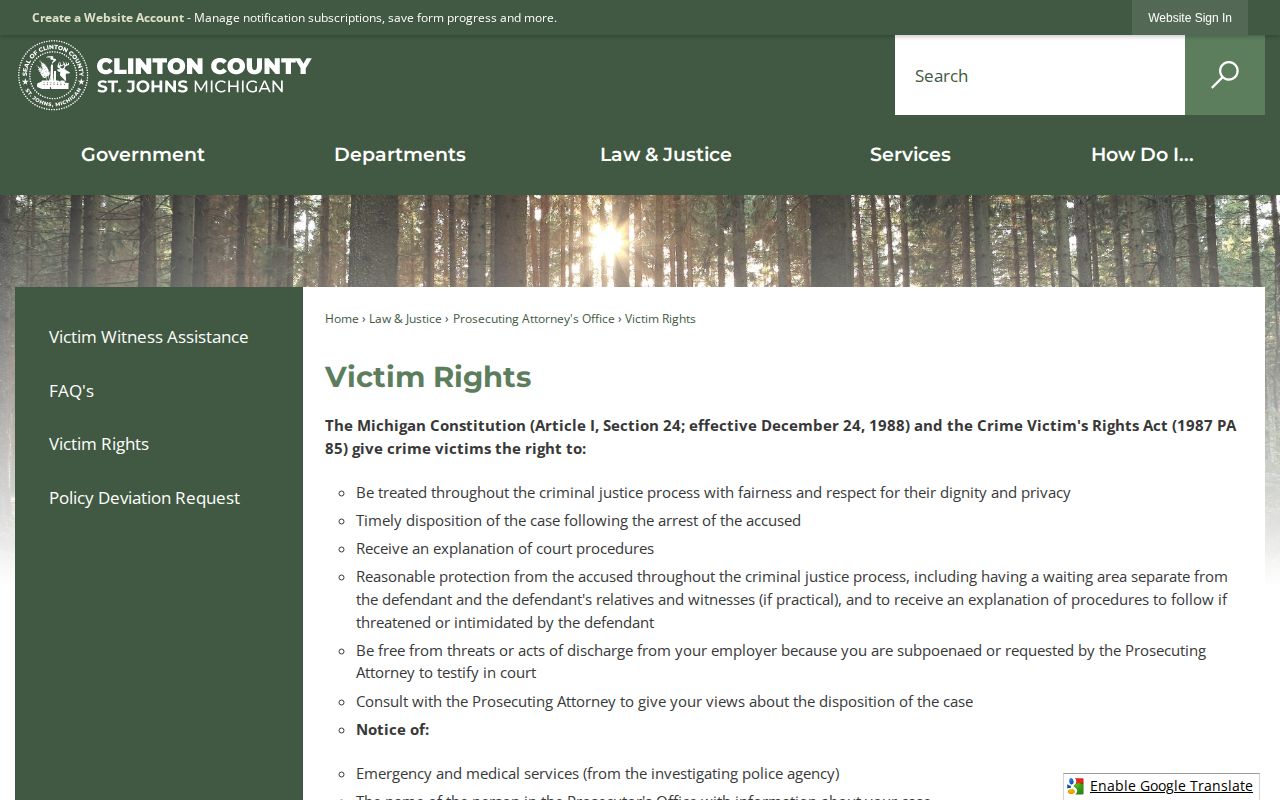
Clinton County adds a local victim-notice layer beyond general VINELink. The official Victim Rights page says that, on an eligible victim’s request, the arresting agency can provide release notice after the Sheriff or facility supplies the custody change. The county material also describes requested notice for day parole or work release.
This is an eligibility-based victim-rights process, not a public inmate search. The arresting agency acts as part of the notice chain. A direct crime victim should ask that agency how to request the local notice and should keep contact information current. MDOC Crime Victim Services remains separate for broader state parole notices.
The official Clinton County victim-rights source is shown below and documents the local release-notice route.
The county layer complements MI-VINE. It does not turn VINELink into a permanent archive or broaden a victim-only process into a public list.
MDOC’s separate notice route matters most when the person is in state prison or on the path to parole. A general VINE custody alert does not promise the full series of parole-eligibility, interview, Board-decision, transfer, and release notices. Eligible crime victims should keep both registrations current when both systems apply. Concerned citizens can review MDOC’s own notice options, but protected case details remain limited.
Fix Clinton County Alert Problems
Repeated phone calls most often mean the message was not acknowledged. Listen through the notice, enter the registered four-digit PIN, and press the pound key. If the PIN is lost, use operator assistance. For a changed email or phone number, update the registration rather than expecting the jail or MDOC to pass the new contact data to VINE.
Search trouble requires a different response. Verify the state, spelling, commitment name, and identifier. Then call the custodian. Clinton County Jail publishes 989-403-5090 as the line for release-date information. Its broader jail and inmate information number is 989-227-6580. For a state prisoner or parolee, use OTIS and the listed supervision office.
Federal custody has its own path. The BOP locator covers sentenced federal custody, while the ICE detainee locator concerns current or recent immigration detention. A county jail departure can be a USMS transfer. MI-VINE cannot be treated as the universal search for those systems.
Confirm Clinton County Release Events
For a Clinton County Jail event, the official inmate-information channel provides the strongest immediate local confirmation. Ask whether the departure was release or transfer. The county court register routes can then explain the legal reason, while the Clinton County FOIA process can seek the existing booking and release entry for durable proof.
For an MDOC person, OTIS provides a different record. PAROLE means the person left prison but remains under supervision. DATE PAROLED identifies actual prison exit on parole. DISCHRG means MDOC jurisdiction ended for the displayed sentence. Those fields should not be collapsed into one generic release label.
Combining the VINELink notice with the direct custodian record resolves most ambiguity. Preserve the as-of time, agency name, and event type. If the sources conflict, ask the reporting office for the underlying entry rather than choosing the result that seems most convenient.
A focused public-record request can preserve a county event after a live notification is gone. Identify the person and approximate booking episode, then ask for an existing record showing booking date and time, release date and time, release disposition, and transfer destination if recorded and disclosable. The County need not create a custom chronology. For an MDOC event, use the department’s own records process because Clinton County does not control the state profile.
Older events need more care. VINELink is not a promised archive, and OTIS public profiles generally remain only within three years after MDOC discharge. Clinton court records can preserve the bond, disposition, judgment, sentence, or probation order that explains the legal event. The jail or MDOC record remains stronger for the actual physical custody change.